L-Arginine vs L-Citrulline: The Complete Comparison
There's a quiet revolution that happened on supplement labels over the past decade, and most people never noticed it. Walk into any gym locker room ten years ago and the pre-workout tubs were dominated by one name: L-arginine. Walk into that same locker room today, and arginine has been pushed to the margins — sometimes dropped entirely — replaced by an amino acid most people had never heard of until it started outweighing every other ingredient in the formula. That amino acid is L-citrulline, and understanding why it staged this takeover tells you almost everything you need to know about how your body actually produces nitric oxide.
This isn't a simple "which one is better" answer. Both amino acids are chapters in the same biochemical story — a story that runs from your gut, through your liver, into your kidneys, and finally out into the lining of every blood vessel in your body. To really understand the difference, it helps to walk through that whole journey.
Two Molecules, One Shared Destination
Both L-arginine and L-citrulline exist for the same ultimate purpose in a supplement context: raising nitric oxide (NO), the gaseous signaling molecule discovered to be so fundamental to cardiovascular biology that the scientists who uncovered its role — Furchgott, Ignarro, and Murad — won the Nobel Prize in Physiology or Medicine for it in 1998. Nitric oxide relaxes the smooth muscle lining your blood vessels, a process called vasodilation. Wider vessels mean more blood flow, more oxygen and nutrient delivery to working muscle, lower resistance for your heart to pump against, and — for lifters — that dense, "fuller" pump feeling during a workout.
Where the two amino acids differ is in the route they take to get there.
L-Arginine is the direct substrate. It's the actual molecule that the enzyme nitric oxide synthase (NOS) grabs and converts straight into nitric oxide, releasing L-citrulline as a byproduct in the process. If nitric oxide production were a factory, arginine is the raw material going straight onto the line.
L-Citrulline is the resupply chain. It doesn't get converted into nitric oxide directly. Instead, once absorbed, it travels to your kidneys, where the enzyme argininosuccinate synthase converts it back into arginine — which then becomes available for nitric oxide production all over again. Citrulline is less a raw material and more the delivery truck that keeps the factory's material supply from running dry.
This distinction — direct substrate versus resupply route — is the single fact that explains almost every practical difference between the two.
The Origin Stories
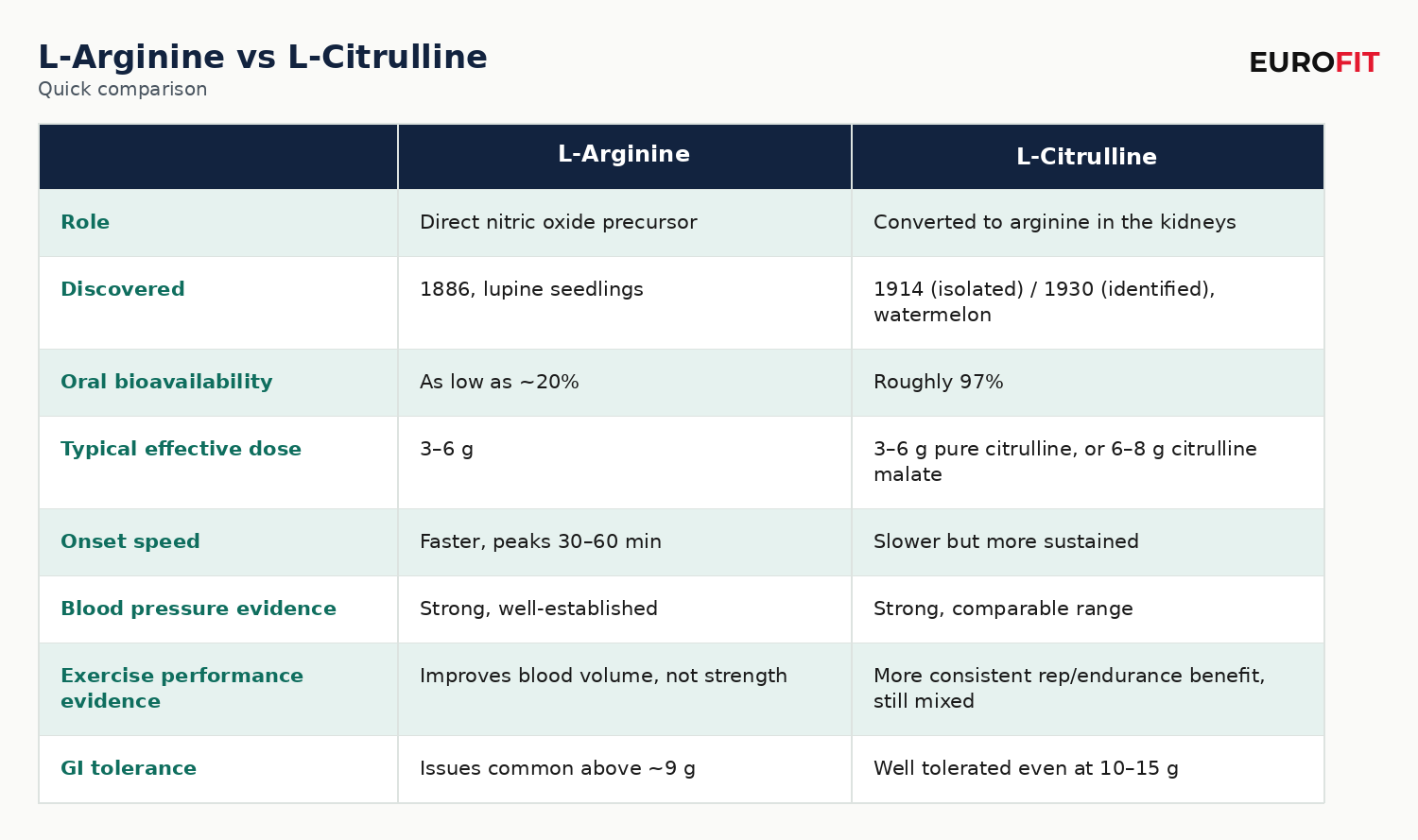
Arginine's discovery dates back to 1886, when German chemists Ernst Schulze and Ernst Steiger isolated a new crystalline substance from young lupine seedlings. They named it after the Greek word árgyros, meaning "silver," for the shiny crystals the compound formed during purification. It would take until 1932, when Hans Krebs and Kurt Henseleit mapped out the urea cycle, for arginine's true metabolic role to come into focus — and it took until the very end of the 20th century for its role in nitric oxide signaling to earn a Nobel Prize.
Citrulline's discovery has an oddly fitting origin for a compound now associated with fitness: watermelon. In 1914, Japanese researchers Yatarō Koga and Ryō Ōtake isolated an unfamiliar amino acid from watermelon juice, though they never determined its structure. That job fell to Mitsunori Wada of Tokyo Imperial University, who in 1930 fully characterized the compound and named it citrulline, after Citrullus, the Latin genus name for watermelon. For decades afterward, citrulline was considered a metabolic afterthought — a mere byproduct of nitric oxide production, not worth supplementing on its own. That perception didn't start changing until researchers realized the byproduct was, in fact, a superior delivery mechanism.
The Absorption Problem That Changed Everything
Here's the discovery that quietly rewrote the sports nutrition industry: oral L-arginine doesn't absorb nearly as well as anyone assumed.
When you swallow arginine, it has to survive two rounds of enzymatic attack before it ever reaches general circulation — first from arginase enzymes lining your gut, and again during first-pass metabolism through your liver. Research has measured the resulting bioavailability at as low as 20% in healthy adults. That means for every gram of arginine you swallow, your bloodstream may only ever see a fraction of it.
Citrulline doesn't have this problem. It isn't a substrate for arginase, so it slips past that first line of enzymatic breakdown almost entirely intact. Pharmacokinetic studies have found that citrulline is absorbed with roughly 97% efficiency in the small intestine. Once it reaches your kidneys and converts to arginine there, it produces a rise in circulating arginine that direct arginine supplementation simply cannot match, gram for gram. One frequently cited figure: taking 6 grams of citrulline raises plasma arginine to a similar or greater degree than 3.2 grams of arginine itself, dosed at twice-daily intervals.
This is why, industry-wide, arginine got demoted and citrulline got promoted. It isn't that arginine "doesn't work" — it's that most of what you swallow never gets the chance to.
What the Research Actually Shows — Side by Side
Blood Pressure and Cardiovascular Health
Both amino acids have real, published support here, and the comparison is close. A meta-analysis pooling 11 randomized controlled trials found that arginine supplementation lowered systolic blood pressure by an average of 5.4 mmHg and diastolic pressure by 2.7 mmHg — a modest but clinically meaningful reduction linked to a real decrease in long-term stroke risk. Citrulline's own pooled data shows a comparable or slightly larger range, with reductions estimated between roughly 4–7.5 mmHg systolic and 2–3.8 mmHg diastolic, depending on the trial set analyzed. In practical terms, neither amino acid clearly outperforms the other for blood pressure — they appear to land in a similar therapeutic range, working through the same downstream mechanism.
Exercise and Strength Performance
This is where the two amino acids start to diverge, and where citrulline pulls ahead in the literature. A randomized, double-blind, placebo-controlled study on resistance-trained men found that a single 6-gram dose of arginine increased muscle blood volume during recovery from lifting — but did not improve strength output. The pump was measurably real; the extra reps were not.
Citrulline tells a more encouraging (if still mixed) story. A crossover study on 41 trained men found that an 8-gram dose of citrulline malate significantly increased bench press repetitions to fatigue compared to placebo, with the gap becoming statistically significant from the third set onward. A broader systematic review found that pre-exercise citrulline dosing was associated with reduced muscle soreness and lower rating of perceived exertion across multiple trials. Not every study agrees — a German Volume Training trial and a study in untrained men both found no measurable performance or recovery benefit — but the overall pattern in recent meta-analyses leans toward citrulline having a small, genuine ergogenic effect that arginine's own research doesn't demonstrate nearly as consistently.
Digestive Tolerance
Arginine has a documented ceiling. At standard doses of 3–6 grams it's generally well tolerated, but above roughly 9 grams in a single serving, nausea, bloating, and loose stools become common — a direct consequence of the unabsorbed fraction sitting in your gut. Citrulline's better absorption translates directly into better tolerance: clinical trials report minimal GI complaints even at doses up to 10–15 grams per day, a side-effect profile that arginine simply can't match at comparable doses.
Combining the Two
Perhaps the most interesting research thread doesn't pit these amino acids against each other at all — it combines them. Multiple animal and human studies have found that a combined dose of L-arginine and L-citrulline raises plasma nitric oxide markers more effectively than either amino acid taken alone, and at lower total doses than either would require individually. One randomized crossover trial in collegiate soccer players found that a combined arginine-plus-citrulline protocol improved 10-minute full-power cycling performance more than placebo. The proposed mechanism is straightforward: citrulline keeps the arginine supply steadily replenished over time, while arginine provides an immediate substrate spike — direct fuel plus a resupply line, working the two ends of the same pathway simultaneously.
Which One Should You Actually Take?
If your priority is a fast, immediate nitric oxide spike right before you train — and you tolerate it well — arginine's quicker absorption curve, peaking within 30 to 60 minutes, can work in your favor for a pre-workout taken close to training time.
If your priority is sustained blood flow, better digestive tolerance, and the more consistent performance research, citrulline (or citrulline malate specifically) is the stronger evidence-backed choice — which is exactly why it has become the default pump ingredient in modern formulations.
If you want the best of both mechanisms, the combination research suggests there's a genuine case for taking them together: arginine for the immediate substrate, citrulline for the sustained resupply. This is increasingly how well-formulated pre-workout and pump products are built, rather than leaning on either amino acid alone.
At Eurofit, our nitric oxide and pump-support formulas are built around exactly this research — dosed within the ranges the science actually supports, whether that's a citrulline malate base, a combined arginine-citrulline stack, or a targeted single-ingredient product depending on your goal.
The Bottom Line
L-arginine and L-citrulline aren't really competitors — they're two ends of the same biochemical pipeline. Arginine is the direct fuel; citrulline is the far more efficient way of keeping that fuel supply topped up. The research consistently favors citrulline when it comes to raising sustained plasma arginine, tolerating higher doses comfortably, and supporting exercise performance — while arginine still holds its own for blood pressure support and offers a faster onset when timing matters. For most people chasing pumps, endurance, or cardiovascular support, citrulline (alone or paired with arginine) is the more evidence-backed place to start.
Sources
- L-Arginine and Blood Pressure Meta-Analysis, PubMed
- Acute l-arginine supplementation increases muscle blood volume but not strength performance, PubMed
- Citrulline malate enhances athletic anaerobic performance and relieves muscle soreness, PubMed
- Oral supplementation with a combination of l-citrulline and l-arginine rapidly increases plasma l-arginine concentration and enhances NO bioavailability, ScienceDirect
- A combination of oral l-citrulline and l-arginine improved 10-min full-power cycling test performance in male collegiate soccer players, National Center for Biotechnology Information
- Arginine, Wikipedia (etymology and discovery history)
- Citrulline, Wikipedia (etymology and discovery history)